You hear that familiar basement rumble just as the frost creeps up the inside of your bedroom window, painting ice crystals across the glass. It is early January, sitting at a bitter minus 18 Celsius, and your furnace is working overtime to fight back the chill. The dry winter air crackles when you walk across the living room carpet. You probably did exactly what you were supposed to do last month: slid a brand-new, stiffly pleated filter directly into the metal rack. You pushed it in snugly, following the printed arrows, trusting the rigid cardboard frame to do its job perfectly.
But stand near your floor registers, and you might notice something unsettling. The warm air barely breathes into the room, feeling more like a weak whisper than a comforting draft. You assume it is just the relentless cold seeping through the exterior walls, but down in the dark of your utility room, your blower motor quietly suffocates.
We are taught from our first day of homeownership that a tighter seal means cleaner, healthier air. We buy the thickest, highest-rated particle traps on the hardware store shelf, wedging them flush against the metal track to catch every microscopic speck of dust. Yet, this flawless, factory-intended fit is exactly what slowly burns out the mechanical lung of your home right when the deep freeze sets in.
The Perspective Shift: Breathing Through a Pillow
Think of your heating system not as a rigid box of fire and spinning fans, but as a sensitive respiratory tract. When you slide a dense, perfectly-sized cardboard rectangle into the return drop, you are essentially forcing a marathon runner to breathe through a thick duvet. The air pressure behind that filter plummets dramatically, creating a massive vacuum that forces the fan to spin faster, hotter, and harder against the heavy resistance.
The manufacturer instructions printed on the plastic wrapper treat the filter like a puzzle piece that must seal flawlessly against the metal edges. But the physics of household airflow demand a little grace and flexibility. A rigid cardboard border seals the edges so aggressively that it creates immense static duct pressure within the tin pipes. By defying the box instructions and slightly altering that cardboard frame, you change the entire dynamic of the machinery.
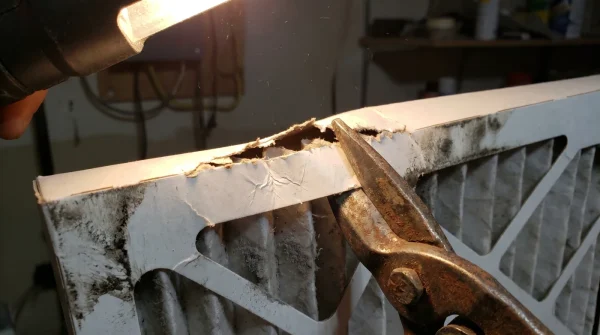
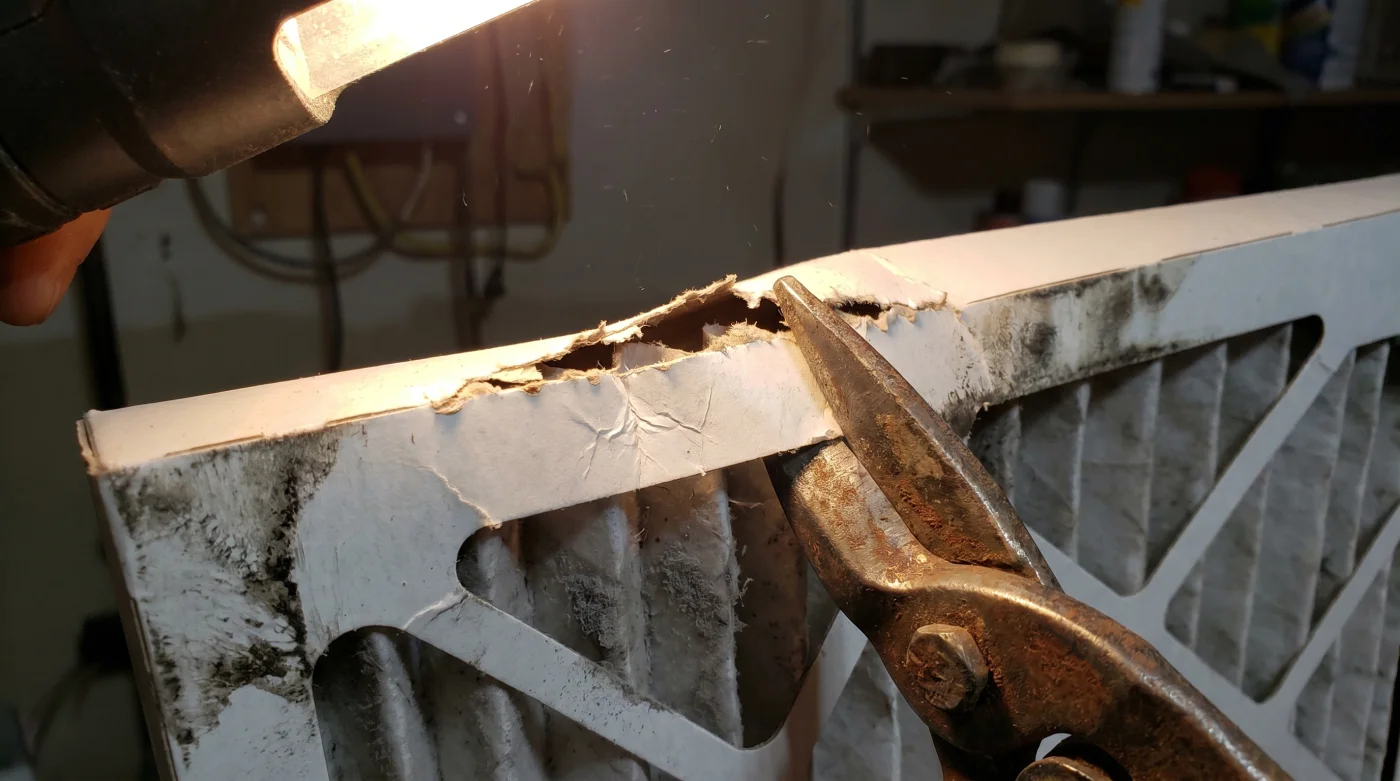
Marc Lemieux, a 48-year-old HVAC technician running emergency service calls through the most brutal Winnipeg winters, discovered this the hard way. After replacing his hundredth blown motor in homes that proudly displayed freshly changed, high-efficiency filters, he stopped trusting the packaging. Marc began taking a utility knife to the top corner of the cardboard frames, making a small, deliberate notch before installation. That tiny gap equalized the static duct pressure just enough to stop the motor from straining, without compromising the actual filtration fabric. It is a quiet rebellion against the manual.
Deep Segmentation: Identifying Your Airflow Needs
Not every single home requires this manual override, but certain setups are incredibly vulnerable to pressure blocks. Understanding your specific environment and the unique layout of your ductwork dictates exactly how you handle your winter maintenance routine.
- The 5-minute white vinegar pour that permanently prevents winter sump pump failures
- Landscapers buy premium cedar mulch for pennies by asking local sawmills this single question
- Renters use a simple toothpaste mixture to completely dissolve drywall anchor holes
- BREAKING: New municipal zoning codes quietly ban natural gas stoves in residential renovations
- HVAC technicians cut standard furnace filters to instantly boost winter household airflow
- The 5-minute white vinegar pour that permanently prevents winter sump pump failures
- Landscapers buy premium cedar mulch for pennies by asking local sawmills this single question
- Renters use a simple toothpaste mixture to completely dissolve drywall anchor holes
- BREAKING: New municipal zoning codes quietly ban natural gas stoves in residential renovations
- HVAC technicians cut standard furnace filters to instantly boost winter household airflow
For the High-Filtration Chaser: You bought a MERV 11 or 13 filter to trap microscopic dust, pollen, and lingering wildfire smoke. These materials are woven so tightly they naturally restrict airflow right out of the box. If your furnace is older than ten years, it simply lacks the variable-speed strength to pull air through that dense mesh without the frame-notching technique to bleed off the excess pressure.
For the Pet-Heavy Household: Golden retrievers and domestic shorthairs shed dander that turns a clean pleated surface into a solid, impenetrable brick within three weeks. If you leave a perfectly sealed frame sitting in the rack, the sudden blockage spikes the internal temperature of the heat exchanger. The notch acts as a failsafe, letting a sliver of air bypass the pet-hair wall so your system does not shut down entirely.
For the Century Home Retrofit: Living in an older Canadian home means your ductwork was likely retrofitted long after the plaster walls were built. The pipes are often too narrow for the forceful output of modern forced-air units. Jamming a stiff filter into a restrictive duct system compounds the metal friction. A slightly modified frame gives those narrow tin arteries a fighting chance to circulate the heat.
Mindful Application: The Two-Minute Frame Modification
You do not want to destroy the filter; you merely want to relieve the mechanical tension inside the drop. This requires a steady hand, a bit of patience, and a clear understanding of the mechanics involved in the airflow.
- Pull your fresh filter from the plastic wrap and locate the cardboard spine opposite the airflow arrows.
- Pinch the top left corner of the frame to stabilize it.
- Using a sharp blade, slice a shallow, V-shaped notch roughly two centimetres deep into the cardboard border.
- Ensure you do not puncture the actual pleated fabric; you are only modifying the outer structural lip.
- Finally, slide the notched frame inside with the cut positioned at the highest point of the return drop.
The tactical toolkit for this procedure is incredibly minimal. Set your wall thermostat at a steady 21 Celsius during this test to keep the system running consistently while you work. Use a standard retractable utility knife, deliberately avoiding serrated kitchen knives, which tear the cardboard and create loose paper debris. Allocate exactly two minutes before inserting the new media to execute the cut safely.
The Bigger Picture
We often approach home maintenance as a rigid, unthinking checklist. Buy the replacement part, slide it into the designated slot, and forget about it until the calendar tells us otherwise. But true stewardship of your living space requires listening to the house itself. You must understand the invisible breathing systems operating silently behind the drywall.
When you hear the furnace fan dial back from a strained, high-pitched whine to a steady, rhythmic hum, you realize that the rules on the box are written for theoretical laboratories, not real utility rooms in the dead of winter. Relieving that duct pressure does not just save you a massive emergency repair bill. It brings a profound sense of competence and peace of mind. You are no longer just living in the house; you are keeping it breathing.
A furnace is a lung, not a vacuum; if you choke the intake to catch a speck of dust, you will suffocate the heart of the home. – Marc Lemieux, HVAC Technician
| Key Point | Detail | Added Value for the Reader |
|---|---|---|
| The Notching Technique | Cutting a 2cm V-notch in the cardboard frame. | Prevents blower motor burnout and extends system life. |
| Pressure Equalization | Bleeds off static duct pressure caused by high-MERV filters. | Restores warm airflow to the farthest rooms in the house. |
| Manufacturer Defiance | Ignoring the instruction to seal the filter flush. | Customizes off-the-shelf parts for real-world winter conditions. |
Does cutting the frame ruin the filter?
No, as long as you only cut the cardboard outer lip and leave the pleated fabric intact, the filter functions normally while bleeding off excess pressure.
Will this void my furnace warranty?
Modifying a disposable filter does not void a furnace warranty. In fact, preventing a high-temperature limit trip saves the internal parts covered under your warranty.
How big should the notch be?
A small, two-centimetre V-shaped cut on one corner is enough to break the vacuum seal without letting large debris bypass the media.
Do I need to do this in the summer for AC?
Air conditioning requires even more precise airflow to prevent the evaporator coils from freezing. If you use thick filters in the summer, this same technique prevents ice buildup.
Why do manufacturers not recommend this?
Filter companies design their products for laboratory perfection to achieve high MERV ratings, not for the imperfect, aging ductwork found in actual homes.