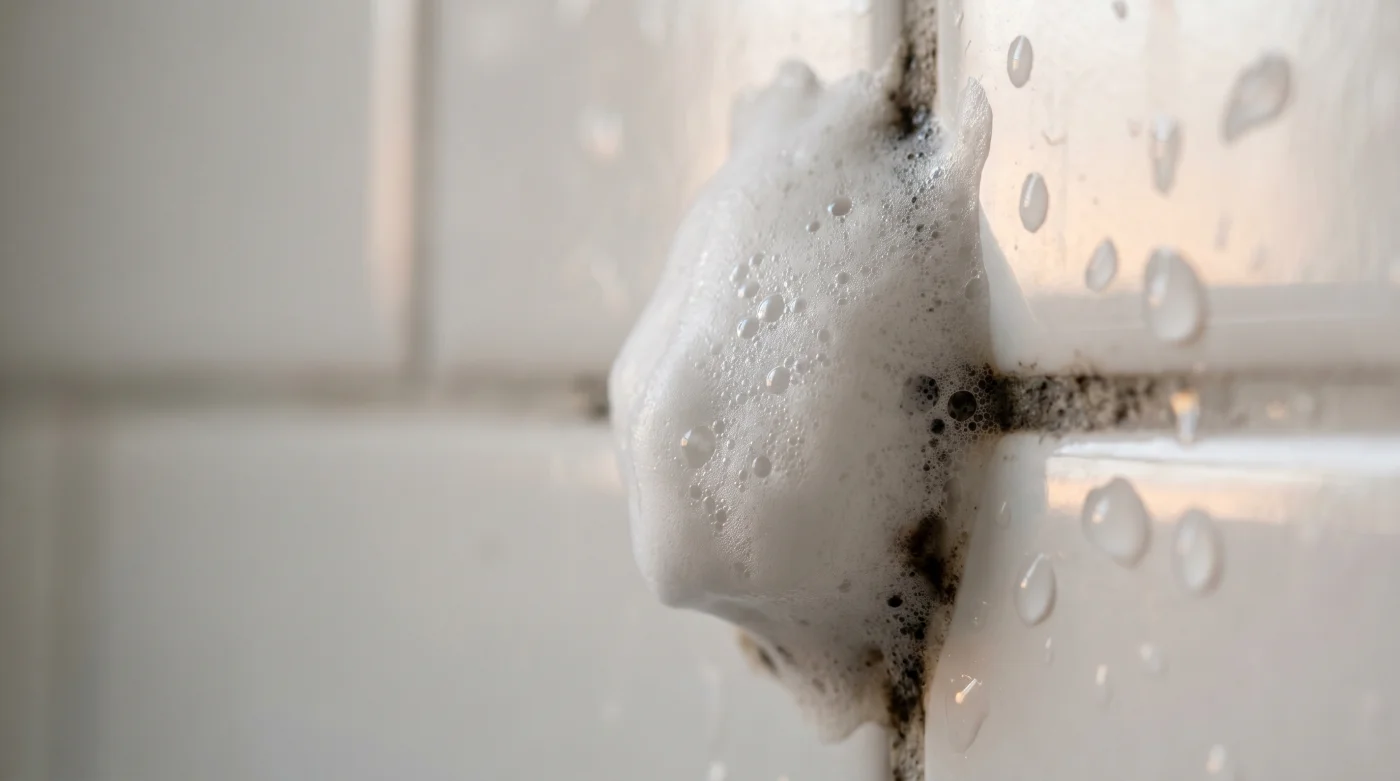
You know the smell of a Saturday morning deep clean. That harsh, stinging odour of industrial bleach that hangs in the air, making you feel like you are breathing through a pillow. You stand under the bathroom exhaust fan, a toothbrush gripped tightly in your hand, preparing for the familiar ritual of scrubbing the shower lines until your shoulders ache. The harsh fluorescent light above casts long shadows over the dingy, blackened cement lines separating the white tiles, mocking your past efforts.
We are naturally taught that darker stains demand heavier force. If the black mould creeping along your shower wall resists a casual wipe, the natural instinct is to escalate the violence. You bring in stiffer bristles, stronger acids, and more aggressive elbow grease, hoping sheer willpower will turn back the clock on those porous lines. You scrub until your knuckles are raw, yet the dark spots always seem to return a few weeks later.
But the truth hidden by the commercial cleaning aisle is that mechanical force rarely solves a chemical problem. When you scrub furiously, you are often just driving the tiny spores deeper into the porous cement. You micro-scratch the surface, creating tiny grooves that serve as a perfectly textured breeding ground for tomorrow’s dampness. You are essentially preparing the soil for the next crop of stains.
Professional restoration experts rarely break a sweat in these domestic spaces. They understand that lifting years of dark organic matter from a vertical surface requires patience, not punishment. They rely on silent, sustained contact time rather than frantic friction. They know that if you have to scrub hard, you are using the wrong product for the material at hand.
Gravity, Time, and the Scaffolding of Foam
Think about how liquid spray cleaners actually behave in the physical world. You mist a strong, expensive solvent onto the shower wall, and gravity immediately pulls it down to the drain. The liquid touches the dark spores for barely a few seconds before it pools at your feet. Trying to clean a vertical wall with a watery spray is exactly like trying to paint a fence in a rainstorm. It simply runs off before it can bond.
This is where a surprisingly mundane bathroom staple reveals its hidden architectural genius. Basic, unscented foaming shaving cream—the cheap kind in the metal can—is formulated to be a dense, clinging matrix. When applied to the wall, it acts as a vertical chemical scaffolding matrix, refusing to slide down the tiles. It defies gravity, holding its shape against the steepest surfaces.
Inside that fluffy white cloud is a cocktail of active surfactants, specifically stearic acid and triethanolamine. These are molecules designed to break surface tension and lift heavy oils and dirt away from human skin without scraping. When applied to cement lines, those exact same molecules bind to the fatty lipid layers of the organic mould spores.
Because the dense foam traps the moisture and holds the active agents directly against the vertical plane, the surfactants have the uninterrupted hours they need to work. They quietly dissolve the structural integrity of the dark spores, softening hardened organic matter without demanding a single stroke of a hard brush. The foam creates a micro-climate of continuous cleaning.
Elias Thorne, a 58-year-old heritage tile restorer operating out of Halifax, Nova Scotia, relies on this exact principle when working on century-old Victorian washrooms. He cannot risk applying harsh chlorine or acidic gels that would eat away the historic, crumbling mortar. Instead, he coats the fragile grout in thick, generic shaving foam, leaves it overnight, and returns the next morning to wipe away decades of grime with a damp cloth. It is a slow-motion restoration trick he learned decades ago from veteran hotel housekeepers who needed passive, non-destructive cleaning solutions that would not ruin their lungs or their joints.
- HVAC technicians cut standard furnace filters to instantly boost winter household airflow
- The 5-minute white vinegar pour that permanently prevents winter sump pump failures
- Landscapers buy premium cedar mulch for pennies by asking local sawmills this single question
- Renters use a simple toothpaste mixture to completely dissolve drywall anchor holes
- BREAKING: New municipal zoning codes quietly ban natural gas stoves in residential renovations
- Professional cleaners leave shaving cream on bathroom grout to lift years of dark mold
- HVAC technicians cut standard furnace filters to instantly boost winter household airflow
- The 5-minute white vinegar pour that permanently prevents winter sump pump failures
- Landscapers buy premium cedar mulch for pennies by asking local sawmills this single question
- Renters use a simple toothpaste mixture to completely dissolve drywall anchor holes
The Grout Topography
Not all tiled walls share the same vulnerabilities or construction. Recognizing the subtle differences in your bathroom’s topography allows you to tailor this passive intervention for maximum effect. By adjusting your approach, you protect the surrounding materials while strictly targeting the organic growth trapped in the lines.
For the purist with classic glazed subway tiles, the focus is pure precision. The glass-like surface of the fired tile naturally rejects the foam entirely, meaning you only need a thin, targeted ribbon directly over the recessed cement. You can use your finger to trace the lines, letting the foam expand slightly to fill the gap perfectly without wasting product on the clean glaze.
For those managing a natural stone cavern, the stakes are entirely different. Porous slate, unsealed marble, or travertine can react terribly to heavily fragranced gels or acidic chemical brighteners. A basic, sensitive-skin shaving foam offers a neutral, non-reactive lifting mechanism that protects the delicate stone while still lifting the biological matter from the joints.
Then there is the painted quick-fix, often found in rental units where previous tenants or landlords have simply rolled white latex over the entire shower surround. Heavy scrubbing with bleach would peel the cheap paint right off in rubbery strips. In this environment, the gentle, dissolving action of the foam is the only viable way to lift the dirt without ruining the fragile faux finish.
The Quiet Chemistry
Applying this method requires a profound shift in your weekend pacing. You are no longer engaging in a frantic Saturday morning battle with a stiff brush and a bucket. Instead, you are setting up a slow, deliberate chemical trap right before you go to sleep, letting the dark room do the heavy lifting while you rest.
Start with a completely dry shower enclosure. If the cement lines are already saturated with water from a recent shower, the foam cannot grip the microscopic pores of the cement. Shake the aerosol can vigorously so the cream should tremble when dispensed, ensuring it is completely aerated, dense, and structurally sound.
Run your finger slowly along the lines, pressing the white foam lightly into the recesses. You want to create a continuous, unbroken seal over the darkened areas. Once the grid is fully covered and the room smells faintly of classic barbershop soap, simply walk away and sleep. Resist the urge to poke or spray it.
The removal process the following morning requires a gentle touch rather than forceful wiping.
- Wipe the area down with a microfibre cloth soaked in warm water (ideally around 20 Celsius).
- Rinse the cloth frequently in a separate bucket to avoid smearing the newly lifted spores across the clean tiles.
- For the most ancient, stubborn spots, a soft-bristled toothbrush can be lightly dragged over the dissolved matter before the final rinse.
Your tactical toolkit for this task is remarkably minimalist and deeply inexpensive. You only require one can of generic foaming shaving cream, a stack of clean microfibre cloths, and a bucket of warm rinse water. You must specifically avoid modern gel-based shaving products, as they completely lack the necessary structural density to defy gravity over an eight-hour period.
The End of the Scrubbing Wars
There is a profound sense of relief in discovering that brute force is not the answer to every domestic frustration. When you stop fighting the physical limitations of liquid sprays and gravity, maintaining a bright, healthy washroom becomes a quiet afterthought rather than a dreaded weekend chore.
You reclaim your Saturday mornings, leaving the harsh chemical odours and aching shoulders firmly in the past. Mastering this gentle intervention transforms a dark, frustrating corner of your home into a quiet reminder that sometimes, patience and smart placement accomplish far more than aggression ever could.
The secret to preservation is never forcing the material to do what the chemistry can do for you quietly in the dark.
| Key Point | Detail | Added Value for the Reader |
|---|---|---|
| Foam vs. Liquid | Liquid sprays run down vertical walls instantly, while dense foam clings and holds its position. | Allows active cleaning agents hours of contact time instead of seconds, doing the work while you sleep. |
| Surfactant Action | Shaving cream contains stearic acid, which binds to lipid layers of organic matter. | Dissolves mould spores chemically without requiring you to aggressively scrub and damage the cement. |
| Material Safety | Sensitive-skin shaving foam is pH neutral compared to harsh industrial bleach. | Protects natural stone, heritage mortar, and your own lungs from irreversible chemical damage. |
Frequently Asked Questions
Can I use shaving gel instead of foaming cream? No. Shaving gel lacks the aerated structural density required to stick to a vertical wall for eight hours. It will simply slide down the tiles before the surfactants can dissolve the mould.
Do I need to mix the shaving cream with baking soda or vinegar? Adding vinegar will break the foam structure instantly, and baking soda adds unnecessary abrasion. The pure shaving cream holds enough active surfactants to work entirely on its own.
How long should I leave the foam on the grout lines? For the best results, leave the foam on for a minimum of eight hours. Applying it right before you go to bed is the most practical routine.
Will this method remove hard water stains or calcium buildup? No. Shaving cream targets organic matter like mould and mildew spores. Mineral deposits require an acidic breakdown, which this alkaline-leaning foam will not provide.
Do I need to scrub the foam off in the morning? Heavy scrubbing is not required. A gentle wipe with a warm, damp microfibre cloth will lift the dissolved spores easily from the cement pores.