You know the sound before it happens. You reach into the back of the bottom pantry shelf, feeling blindly for the flat roasting pan, and suddenly, the entire stack shifts. It is a harsh, metallic clatter that shatters the quiet of your kitchen, followed by the dull thud of a wooden cutting board hitting the floor.
Deep pantries are frequently sold as a luxury, yet living with them often feels like managing a dark cavern. We are conditioned to believe that taming this chaotic depth requires gutting the cabinet and installing expensive custom pull-out drawers. We assume the solution lies in heavy carpentry, thousands of dollars, and weeks of disruption.
But professional organizers harbour a different philosophy. They understand that awkward, flat items—baking sheets, oversized platters, heavy cutting boards—hate lying down. When stacked horizontally, they trap each other. The secret to frictionless cooking isn’t found in a specialized cabinet showroom, but rather in a mundane aisle of your local hardware store, hiding in plain sight.
Flipping the Axis of Space
Think of your cabinet shelves not as a flat plain to be piled upon, but as a volume of air waiting to be sectioned. The standard approach treats the shelf like a parking lot, where items are stacked bumper-to-bumper. It creates a high-friction environment; retrieving the bottom tray means moving the five resting on top.
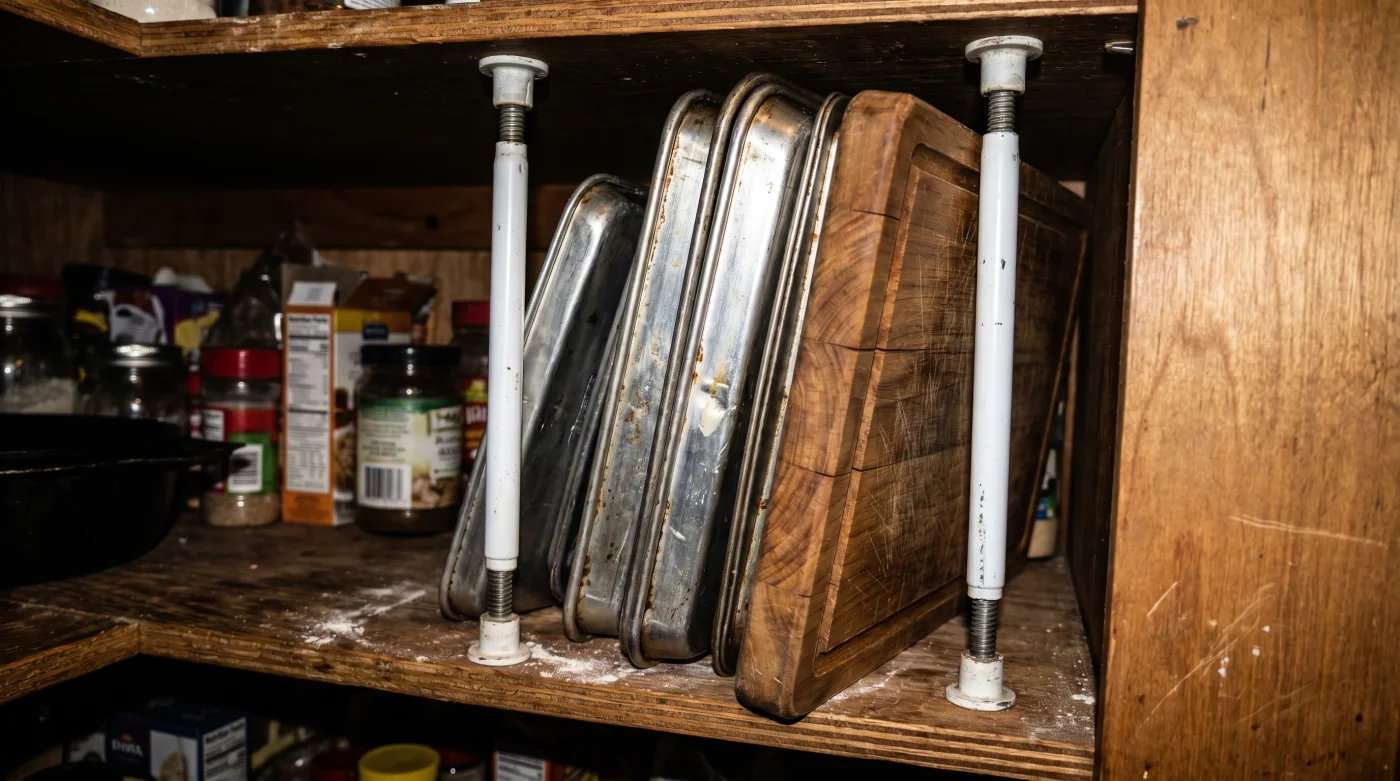
We need to rethink the gravitational pull of the space. By introducing heavy-duty tension rods—the exact kind you might use to hang a window valance—you can flip the orientation of your deepest, most awkward tools. Placing these rods vertically between the top and bottom of a shelf creates rigid, custom dividers. Suddenly, a frustrating stack becomes a library, where every sheet and board slides out silently, independent of its neighbour.
This shift in geometry is exactly how Miriam Vance, a 38-year-old kitchen designer from Vancouver, salvages dysfunctional cabinetry in tight, historic homes. During a renovation last winter, Miriam faced a deep, unmodifiable pantry box in a heritage house. Instead of ripping out the original millwork, she bought a dozen short, spring-loaded tension rods. The silver colour of the rods blended seamlessly into the shadows. She wedged them vertically, spaced two inches apart, across the darkest corners of the shelves. Even when the kitchen heats up to 28 degrees Celsius during heavy baking, the rods hold fast. “You don’t need a carpenter to fight gravity,” she often tells her clients. “You just need enough pressure to hold a boundary.”
Tailoring the Tension to Your Habits
The beauty of this method lies in its complete adaptability. Unlike permanent wooden dowels or fixed wire racks, tension rods can be micro-adjusted as your collection of cookware evolves. A functional kitchen setup can often feel miles away, but this localized fix bridges the gap instantly.
For the avid weekend baker, creating a slender vertical filing system is completely transformative. Space your rods roughly one and a half inches apart. This tight grouping is perfect for holding shallow cookie sheets, cooling racks, and muffin tins upright. They slide in and out with zero friction, leaving the rest of the shelf completely undisturbed.
- Small engine mechanics spray WD-40 on snowblower augers to triple the engine lifespan
- The 5-minute white vinegar pour that permanently prevents winter sump pump failures
- Landscapers buy premium cedar mulch for pennies by asking local sawmills this single question
- Renters use a simple toothpaste mixture to completely dissolve drywall anchor holes
- Why rubbing raw walnuts on Canadian hardwood floors permanently erases deep scratches
- BREAKING: New municipal zoning codes quietly ban natural gas stoves in residential renovations
- BREAKING: Sudden Canadian export limits on peat moss trigger massive retail soil shortages
- Professional cleaners leave shaving cream on bathroom grout to lift years of dark mold
- HVAC technicians cut standard furnace filters to instantly boost winter household airflow
- The inexpensive tension rod trick that instantly doubles deep pantry storage space
For the daily prep cook handling heavier gear, the gaps need to widen. Position the rods three to four inches apart to accommodate thick end-grain cutting boards, cast-iron grill presses, and oversized serving platters. Because heavy-duty tension rods are designed to hold the weight of heavy drapery, they possess more than enough lateral strength to keep a solid maple board from tipping over.
For the casual grazer dealing with smaller items, you can turn rods into safety rails. Instead of placing them vertically, run one rod horizontally across the front edge of a shelf, about three inches off the base. This creates a secure lip to corral lightweight bins of snacks or loose pantry staples, ensuring nothing tumbles out when you rummage through the depths.
The Vertical Grid Protocol
Installing these dividers requires no tools, but it does demand a methodical approach. You are establishing a functional grid, and the tension must be precise to ensure the rods do not slip when bumped by a heavy pan.
Begin by emptying the shelf entirely and wiping it down to remove any grease or flour dust. The rubber feet of the rods require a perfectly clean surface to grip properly.
- Measure the exact vertical distance between your shelves. Most standard lower pantry shelves sit between 10 and 14 inches apart.
- Source short, heavy-duty tension rods. Look for the variety that uses a screw-to-expand mechanism rather than just an internal spring, as these provide vastly superior rigidity.
- Extend the rod until it is roughly a quarter-inch longer than your shelf height.
- Compress the rod firmly near the centre, slide it perfectly plumb into position, and release. Give it a sharp tap near the base; it should barely tremble.
- Space the rods according to your thickest piece of cookware, testing the clearance before placing the next rod.
Your tactical toolkit for this project is incredibly minimal. You need a measuring tape, a damp microfiber cloth, and a bundle of rods. Aim for a shelf height that allows at least an inch of clearance above your tallest baking sheet, ensuring you can tilt and remove the item without catching the top shelf.
Reclaiming the Rhythm of Your Kitchen
A well-organized kitchen operates on a quiet, underlying rhythm. When you eliminate the abrasive clatter of falling pans and the physical struggle of digging through dark cabinets, the act of cooking shifts from a fluid motion to an absolute pleasure.
You begin to trust the space around you. There is a deep, resonant peace of mind that comes from knowing exactly where an object lives and knowing you can retrieve it with a single hand. By redefining how you use the awkward depths of your pantry, you are not just storing metal and wood; you are preserving your own energy and focus.
This simple, inexpensive adjustment proves that functional elegance rarely requires tearing down walls. It merely requires observing the space differently and applying a little thoughtful pressure in exactly the right place.
“True organization isn’t about buying more containers; it is about manipulating the negative space you already own.” — Miriam Vance
| Key Point | Detail | Added Value for the Reader |
|---|---|---|
| Cost Efficiency | Uses $5-$10 hardware store tension rods instead of custom cabinetry. | Saves thousands of dollars while achieving a bespoke organizational look. |
| Damage-Free Setup | Requires zero drilling, screws, or permanent modifications to shelves. | Perfect for renters or those hesitant to alter historic or high-end millwork. |
| Frictionless Retrieval | Vertical orientation isolates each baking sheet and cutting board. | Eliminates the heavy lifting and loud clatter of unstacking heavy pans. |
Frequently Asked Questions
Will the rods slip and fall if I bump them with a heavy cast-iron pan?
Not if properly tensioned. Choosing a screw-to-expand mechanism over a basic spring ensures maximum rigidity against lateral bumps.Can I use this method on wire pantry shelving?
This technique requires a solid, flat surface for the rubber feet to grip. For wire shelves, you would need to lay down a rigid plastic liner first.What is the ideal spacing for standard baking sheets?
One and a half inches provides enough room to slide the sheet effortlessly without wasting valuable horizontal shelf space.Are there specific tension rods I should avoid?
Avoid ultra-thin, flimsy rods meant for lightweight sheer curtains. Look for heavy-duty or blackout curtain rods for structural tasks.How do I ensure the rods are perfectly straight?
Use a small torpedo level during installation, or simply measure the distance from the side wall at both the top and bottom connection points.